

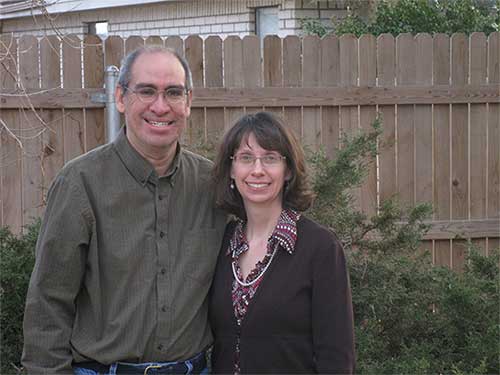
Dr. Varela and his wife, Ann
He has had an interest in the sciences since he was a kid when his parents gave him an old, used microscope.
"I enjoyed many hours just looking at stuff. It was great! My dad once told me to figure out what my favorite thing is and then get a job where you're paid to do that.
"I like learning new things, so, strangely enough, becoming a professor helps me also to continue my love of learning. As the sciences progress, I like to keep up with the newest developments and share them with my students," explained Dr. Varela.
His favorite fields of study are the biochemistry of microbes using molecular biology.
"I love biochemistry because it fascinates me how a living being can actually do real chemistry without needing beakers and a flame to do so! I started loving DNA immediately after I read the book called "The Double Helix" by James Watson, who along with Francis Crick and Rosalind Franklin discovered the structure of DNA," said Dr. Varela.
He has been hooked on molecular biology ever since.
"I love microbes because they can do whatever we can do, and they can do whatever we can't do. They're amazing little creatures, especially the bacteria. Were it not for them, there would be no other life on earth," said Dr. Varela.
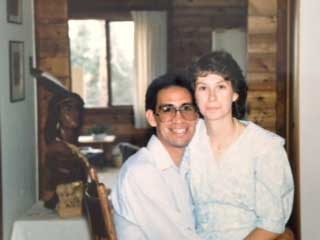
Dr. Varela's engagement photo
He follows the human face transplant studies even though he's not technically a human biologist.
"When I teach Immunology to upper-division and graduate students, we'll read and discuss the latest papers in this particular area each year. The students seem to enjoy the papers, too.
"I also follow new studies that demonstrate that microbes cause new diseases that we normally don't think might be caused by microbes, like diabetes or cancer," said Dr. Varela.
His favorite thing about teaching is getting an occasional correspondence from a grateful alumnus who thanks him and says they are still benefiting in some way due to the things he taught them when they were in college or graduate school.
"Grateful alumni make teaching rewarding to me," said Dr. Varela.
Some of Dr. Varela's mentors include Dr. Louis Pasteur, "father of microbiology and, in my opinion, of biochemistry, and Dr. Hans Krebs, discoverer of the citric acid cycle, a key pathway in intermediary metabolism."
He also includes his former postdoc advisor, Dr. Thomas Wilson, "who was not only an intelligent and gifted scientist, but also an extremely kindhearted human being.
"It's heartwarming to know that the two characteristics, gifted intelligence and kindheartedness, can go together because. Unfortunately, they aren't very often found together," said Dr. Varela.
His greatest accomplishment is that he has been married for 25 years "to a lovely, talented, funny, and extremely clever wife and have two really neat children," said Dr. Varela.
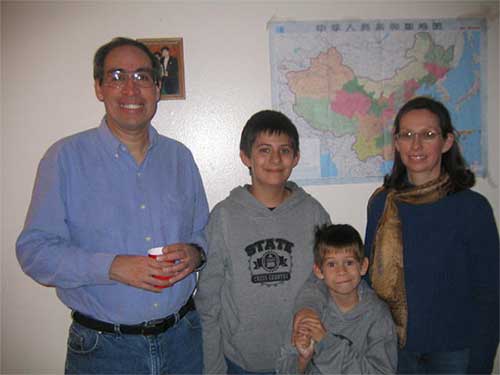
(R-L) Dr. Varela, Timothy, Edward and Ann
"I am totally blessed and fortunate to have them about. They bring me joy," explained Dr. Varela.
"My lovely wife, Ann, can sew like a saint and garden like a genius, and vice-versa. She can astutely play the violin and solve just about any puzzle. She is a maker of fine huevos rancheros," explained Dr. Varela.
Mrs. Varela can also recall the song title to just about any song based on hearing only two notes. She has formal training and expertise in behavior disorders and gifted learning, "both skills of which she effectively uses to keep me in firm control."
Dr. Varela's oldest son, Timothy, is an Eastern undergraduate and keeps him rooted in the latest technology of his generation and has a real talent with computers. He solves all of their computer problems.
His youngest son, Edward, is a high school junior. He was just inducted into the National Honor Society. He also teaches Dr. Varela about good jazz and 60s music.
"Both boys have nicknames that they don't like. So I shan't tell you what their nicknames are," said Dr. Varela.
He was born and raised in Santa Fe, New Mexico.
"We played outside, got dirty, played fort, played with cars, spaceships, dogs, and cats, and we thoroughly enjoyed every minute it. I spent many summers with my grandmother in Pecos, New Mexico, and I greatly enjoyed the small-town atmosphere," said Dr. Varela.
He also spent many summers with his aunt and uncle in Bandelier where he routinely hiked the trails up and down Frijoles canyon.
His mom was a nurse and his dad was a janitor in the old St. Vincent's hospital in Santa Fe.
"Being obviously poor, they couldn't afford a babysitter when I was a toddler. Thus, I was routinely taken along with them to work, and it was great, at least for me. My mom was in the geriatrics ward. Some of my earliest memories are of playing in the nurses' station and visiting the patients in their rooms. I learned quickly a valuable lesson that there were two kinds of elderly people: kind and cranky," explained Dr. Varela.
Dr. Varela likes music of any kind that's been composed between 1550 and 1969. He also played the drums when he was a kid, for a total of two days. His favorite hobbies are reading non-fiction books, mainly history, and listening to music.
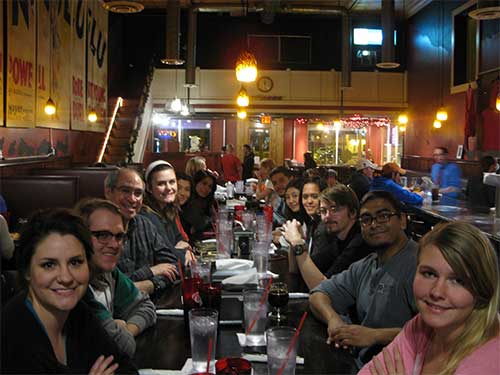
Celebrating a publication of a paper
Dr. Varela's Top Ten memorial, and enjoyable moments from his career include:
(1) publishing his first paper in a scientific journal when he was 23 years old;
(2) conducting rat brain surgery as an undergraduate student to learn behavioral neuropharmacology;
(3) cloning his first gene;
(4) making his first set of bacterial mutants;
(5) getting postdoc offers from Yale, Cornell, Johns-Hopkins, Dartmouth and Harvard;
(6) going to Harvard as postdoc and studying the famous lactose permease;
(7) being the first to discover the multidrug efflux pump known as "LmrS" from the dread MRSA bacteria;
(8) participating in the DNA sequencing of an entire genome of a "good cholera" bacterium;
(9) being a recipient of Eastern's Presidential Award for Excellence in Scholarly Activity;
(10) getting his very own research laboratory in which to play.
Dr. Varela decided to become a university teacher because it's "the best way to share knowledge, and I really like doing that. I do remember that when it was time to choose, during my postdoc years, I couldn't decide between academia versus biotechnology. So when I began teaching medical students, I figured if the students liked me, then I would become a professor."