Chasing a
Vanishing Species
Chasing a
Vanishing Species
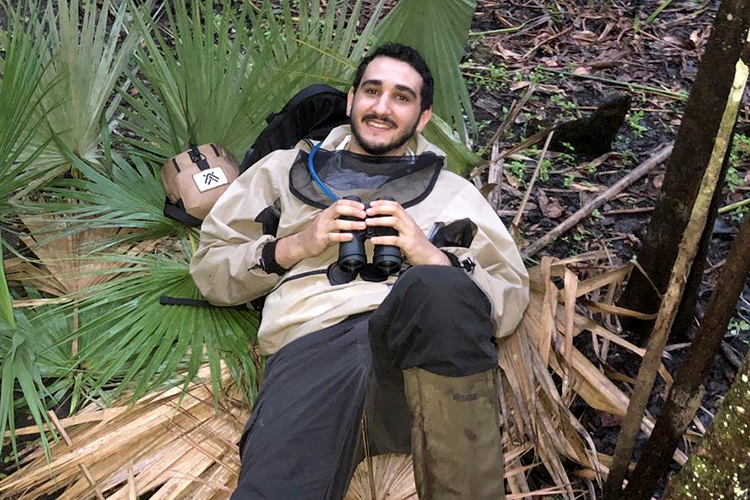
Before there were research grants or field notes, there was a barefoot kid crouched in the Florida heat with his hands in the grass and his eyes fixed on the ground. There, palms swayed above him, sprinklers hissed across the lawn, and lizards skittered across stucco walls, vanishing into sunlit cracks. Sebastian Summo-Elias (MS 26) spent countless hours tracking the twitch of a tail through the grass or the faint blur of motion at the edge of his vision. Long before he ever knew the word herpetologist, he was learning to see how the world moved in small, quick ways.

His curiosity found endless outlets in the tangled green, swampy sprawl of Miami. One of Summo-Elias's earliest scaly memories is of a basilisk, a green and brown lizard with a plume on its head, known for its ability to walk on water. Locals call it the "Jesus lizard." Summo-Elias trailed it to the concrete edge of his backyard pool, thinking he had it cornered, and the lizard bolted, skimming the length of the pool, escaping with its toes slapping against the water as if it were solid ground. "To see a lizard run on the freaking water, like who would've thought? That was cool," he said.
The backyard he explored shrank with the years, but the pursuit never did, and at some point, chasing lizards turned into something more. Summo-Elias traces it back to high school, when an environmental science class introduced him to conservation as a career path.
“I feel like it’s part of my identity to try and conserve these areas for future generations to see. It’s my responsibility.”
"I lived really close to the Everglades, and I think it's one of the most beautiful places in the U.S., filled with a bunch of wildlife that you can't find anywhere else," he said. "I feel like it's part of my identity to try and conserve these areas for future generations to see. It's my responsibility."
He made his way to the University of Florida and graduated with a bachelor's degree in wildlife ecology. His research interests lead him to work in a mammalogy lab studying the effects of invasive pythons on native mammals.
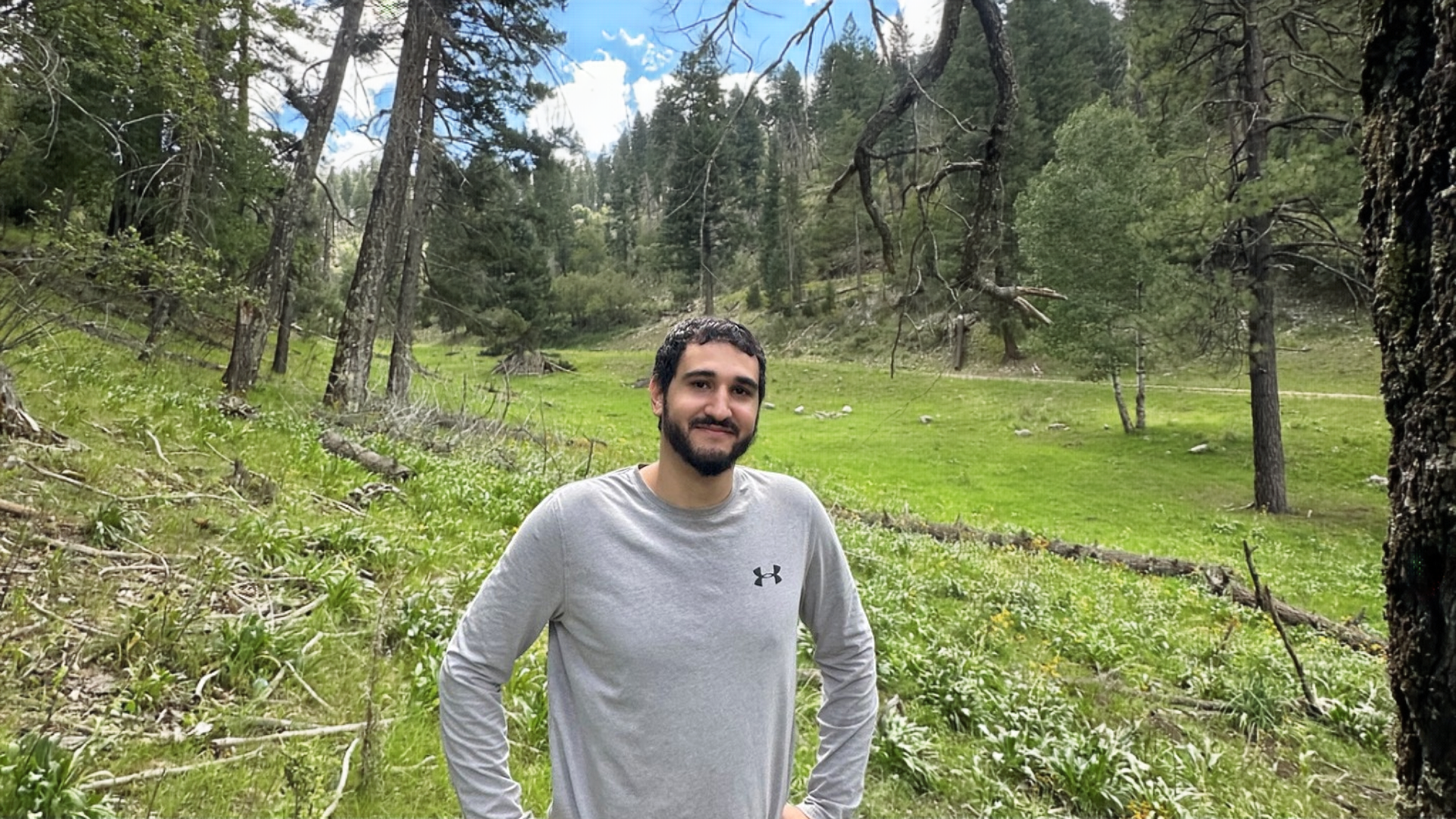
"One of the things I've noticed from childhood to now is just how much the environment changes, and how our decisions collectively shape that," Summo-Elias said, "and it's easy to feel like you don't have much influence. But the more I've studied this, the more I realize that what we do actually matters." Because of this, he knew that he wanted to stay in research, keep working with reptiles, and contribute to conservation in a way that felt personal and direct.
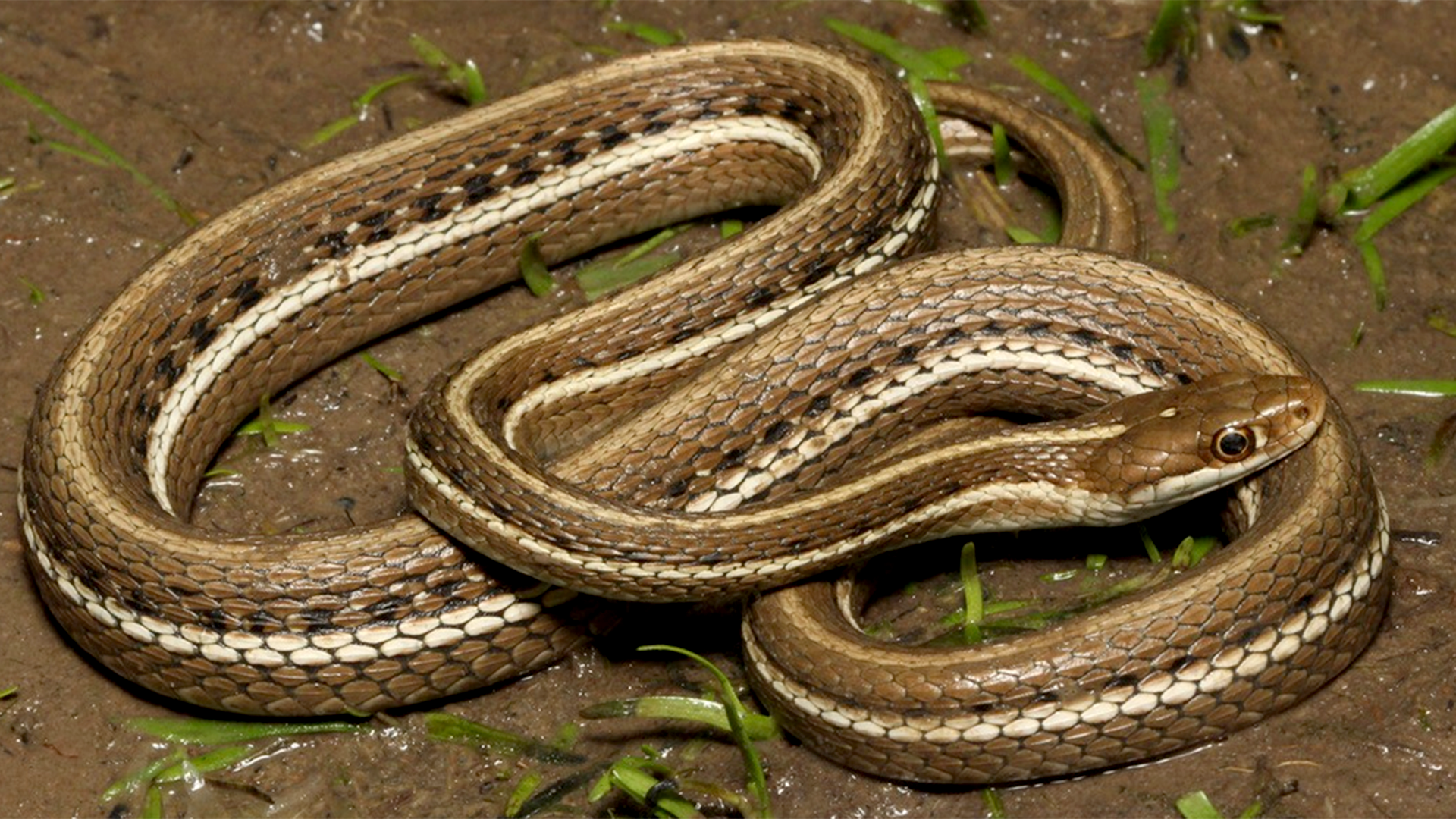
His girlfriend, a graduate student at New Mexico State University, spotted an opening in Eastern New Mexico University's graduate program and sent it his way. "I looked into it more and saw that Dr. Davis' work lined up really well with what I wanted to do," he said. Dr. Drew Davis, assistant professor of herpetology, was leading a project focused on the Western Ribbon Snake, a slender, semi-aquatic species clinging to the edges of New Mexico's rivers, streams, and wetlands. Once common across parts of the Southwest, it's now considered state-threatened, meaning its population is declining and at risk within New Mexico's borders. With a project centered on snakes and the location near his girlfriend, Summo-Elias submitted his application and started at Eastern in January 2024.
While the Western Ribbon Snake is rare in the state, it's still widespread just across the Texas border. In a region where drought is constant, and water dictates every decision about what can grow and live, Summo-Elias saw the intimate connection between the fate of a species and the land itself, and how easily that delicate balance can shift. The scarcity of water here, paired with the snake's abundance elsewhere, makes it so the species is often overlooked. "Since they're super common in other states, people don't really look out for them here," he said.
He was awarded the 2024 Howard McCarley Student Research Award, a competitive grant that provided $1,000 to expand his project and cover additional lab analyses.
By fall 2024, he and Davis had collected enough data to present at the Annual Meeting of the Southwestern Association of Naturalists (SWAN) in Aguascalientes, Mexico. This opportunity placed Summo-Elias in conversation with researchers from across the region with research interests that matched his. A few months later, he was awarded the 2024 Howard McCarley Student Research Award, a competitive grant that provided $1,000 to expand his project and cover additional lab analyses. "It was really validating," he said about the grant, "it gave me the freedom to expand the project and to start looking at things like snake fungal disease, which could be another big threat that's just flying under the radar."
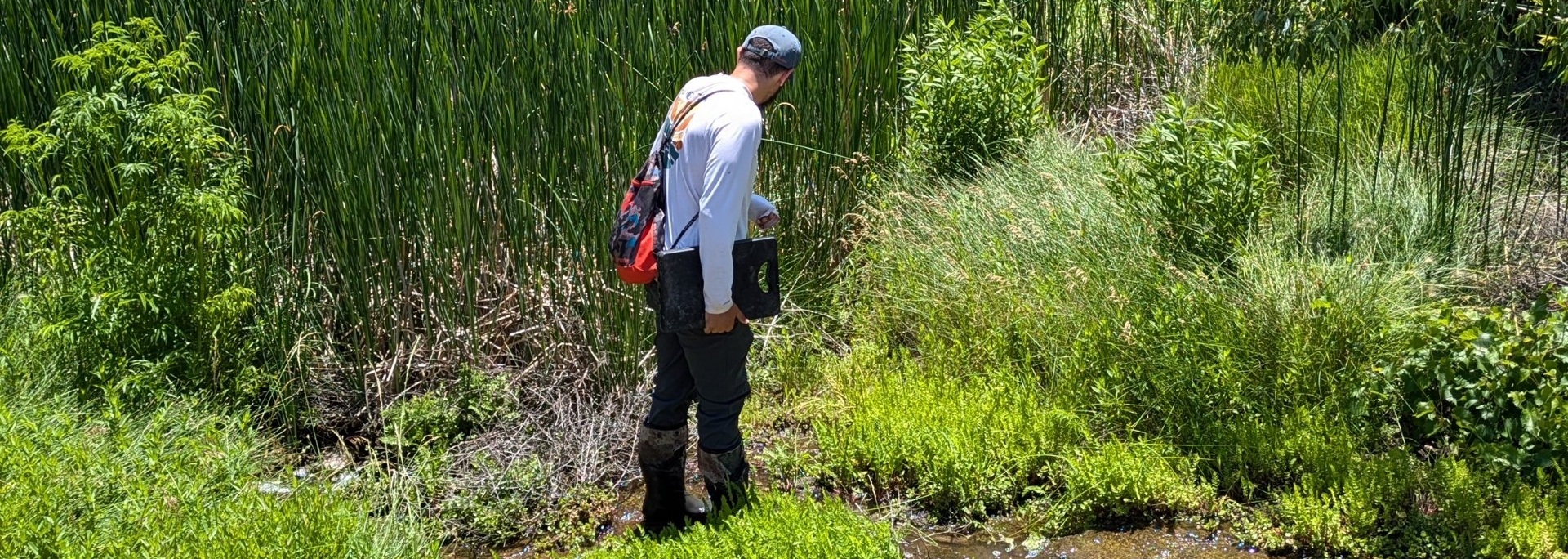
On the sun-soaked banks within Bottomless Lakes State Park, nine ribbon snakes poked their heads through the mesh of a minnow trap, Medusa's hair brought to life. It was a rewarding sight for Summo-Elias, marking one of the first successful captures in his months-long study of New Mexico's Western Ribbon Snake that the grant allowed him to continue. "That was really awesome," Summo-Elias said, still taken aback.
“We kind of take for granted some of the things we see every day, but we may lose them in the future if we’re not diligent. If I can help preserve even a little piece of that for the next generation, that’s worth it.”
Now, the data he's collected will inform his thesis and, maybe down the line, support on-the-ground conservation efforts for animals that are easy to overlook but are worth protecting all the same, like the Western Ribbon Snake.
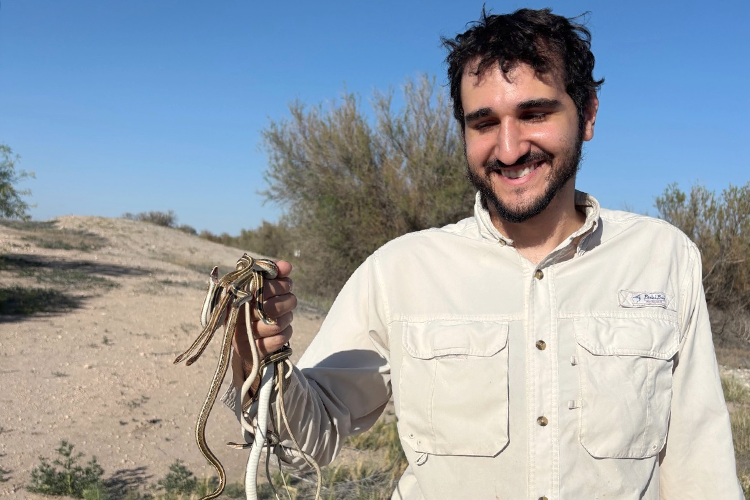
Eventually, Summo-Elias hopes to earn a Ph.D. to continue his work with reptiles and amphibians, and mentor students of his own. He already has a glimpse of that in the field, having guided undergraduate technicians over the past two summers. He's taught them to embrace the grit of fieldwork. From the mud that steals their shoes, or the sting of bugs, to the countless hours tracking the twitch of a tail through the grass or the faint blur of motion at the edge of their vision. When their eyes catch the shimmer of scales to follow a ribbon snake as it wisps through the water, he sees something familiar take hold. "That's where it starts; just seeing something cool and wanting to know more about it," he said.
"We kind of take for granted some of the things we see every day," he said. "But we may lose them in the future if we're not diligent. If I can help preserve even a little piece of that for the next generation, that's worth it."
For now, Summo-Elias is focused on finishing his project, running lab samples, and chasing down the next handful of slippery ribbon snakes. In a state where water shapes what can survive, each snake he finds feels like a small victory, a glimpse of what's still holding on.